You don’t need a design degree, expensive software, or a hired freelancer to create graphics that make your affiliate marketing look professional.
You need the right free tools — and a bit of guidance on how to use them well.
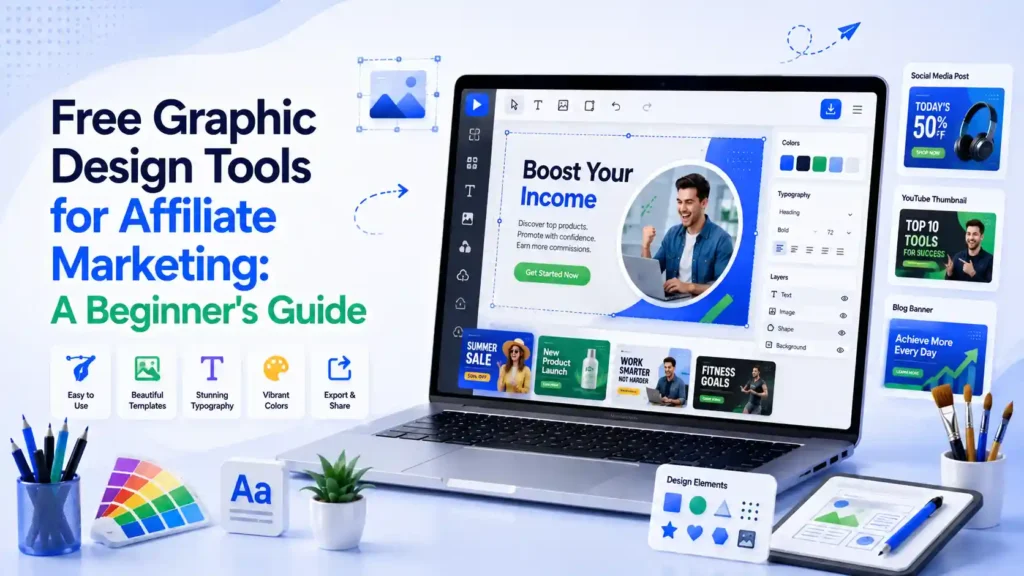
This guide covers the best free graphic design tools for affiliate marketing, including how Canva fits into a beginner’s workflow, how to create banners for free, and which tools are actually worth your time heading into 2026.
By the end, you’ll have a simple toolkit to create clean, click-worthy marketing graphics without spending a cent.
Uncover My Top Recommendation for Making $100-$300 Daily – Check Out This FREE Video to Begin >>>
What Are Free Graphic Design Tools for Affiliate Marketing?
Free graphic design tools are browser-based or downloadable platforms that let you create visuals — banners, social graphics, thumbnails, and promotional images — without needing professional design software or advanced skills.
For affiliate marketers specifically, these tools typically cover a few core needs:
- Social media graphics, for promoting products across platforms
- Banner ads, for websites, blogs, and email campaigns
- Product comparison visuals, to help audiences make decisions
- Thumbnails and cover images, for blog posts and video content
Most beginners can cover all of these needs using just one or two well-chosen free tools.
Why Free Design Tools Matter for Beginner Affiliates
Visual content directly affects whether people stop scrolling, click your link, or trust your recommendation. Here’s why the right tools matter early on.
- First impressions are visual. A clean, professional-looking graphic builds instant trust, while a sloppy one can undercut even great content.
- Consistency builds recognition. Using the same free tool to create a consistent visual style helps your brand become recognizable over time.
- Budget matters most at the start. Most beginners aren’t earning consistent commissions yet, so spending on design tools or freelancers too early can drain a budget that should go toward traffic or content instead.
- Free tools have genuinely improved. The gap between free and paid design tools has narrowed significantly, meaning beginners no longer have to sacrifice quality to stay on a $0 budget.
Step-by-Step Guide: Creating Marketing Graphics as a Beginner
Follow this simple process to go from zero design experience to consistent, professional-looking graphics.
Step 1: Choose One Primary Tool
Rather than juggling several platforms, pick one main free tool that covers most of your needs and commit to learning it well. Canva remains the most popular starting point for affiliate marketers specifically because of its simplicity and massive built-in template library.
Step 2: Set Up a Simple Brand Kit
Before designing anything, choose two or three consistent colors, a font pairing, and (if you have one) a logo. Most free design tools let you save these as a reusable brand kit, so every graphic you make afterward stays visually consistent.
Step 3: Start With Templates, Not Blank Canvases
As a beginner, don’t design from scratch. Use existing templates inside your chosen tool and simply swap in your own text, colors, and images. This alone will make your graphics look far more polished than starting from nothing.
Step 4: Learn to Create Banners for Free
Most free tools include preset banner sizes for common ad placements and social platforms. Pick a template close to your intended use, adjust the text and call-to-action, and export it in the correct dimensions for wherever you plan to use it.
Step 5: Build a Small Library of Reusable Templates
Once you’ve created a few graphics you’re happy with, save your own versions as templates. This turns future graphic creation into a five-minute task instead of starting fresh every time.
Step 6: Expand Your Toolkit Only When You Hit a Real Limitation
If your primary tool can’t do something you genuinely need — like advanced photo editing or vector-based logo work — that’s when it’s worth adding a second free tool to your workflow.
Uncover My Top Recommendation for Making $100-$300 Daily – Check Out This FREE Video to Begin >>>
The Best Free Design Tools for Affiliate Marketers in 2026
Canva continues to be the most beginner-friendly option, thanks to its enormous free template and stock image library and its drag-and-drop simplicity.
For most affiliate marketers, Canva alone can cover social graphics, banners, and thumbnails without ever needing a paid plan.
For more advanced vector work, like creating a clean logo or scalable graphic, Affinity has become a genuinely strong option now that it’s available at no cost, offering more precise, professional-grade design control than Canva’s template-based approach.
If you need quick photo editing — cropping, adjusting, or cleaning up an image before dropping it into a design — Photopea and Pixlr are both solid browser-based options that require no downloads or sign-up friction.
For marketers who want more animated or video-style graphics, VistaCreate offers a large free template library specifically geared toward social-first content, which can help your promotions stand out in busy feeds.
If you eventually collaborate with a partner or virtual assistant on design work, Figma’s free tier supports real-time collaboration, though it has a steeper learning curve than Canva and suits more advanced design needs than most beginners require right away.
Common Mistakes Beginners Make With Marketing Graphics
- Overcomplicating early designs. Beginners often try to add too many elements, when a clean, simple graphic usually converts better.
- Ignoring platform-specific sizing. A banner that looks great on a blog can get awkwardly cropped on social media if you don’t adjust dimensions for each placement.
- Inconsistent branding across graphics. Switching colors, fonts, or styles constantly makes your content feel less trustworthy and harder to recognize.
- Using low-quality or irrelevant stock images. A generic, unrelated image can actually hurt credibility more than having no image at all.
- Spending too much time perfecting one graphic. Especially early on, “good enough and published” beats “perfect and never finished.”
Pro Tips for Better Marketing Graphics on a Free Budget
Keep your text minimal on any banner or graphic — a strong, short message almost always outperforms a cluttered one packed with detail.
Reuse your brand kit religiously across every platform, since visual consistency builds recognition faster than any single “perfect” design.
Batch-create several graphics in one sitting using the same template, swapping only the text and image, rather than starting a new design process every single time you need something new.
Study graphics from affiliates or brands you admire in your niche, not to copy them directly, but to understand what layout and messaging choices seem to be working.
Finally, don’t wait for design skills to “catch up” before publishing. Most audiences respond far more to clear, useful content than to graphic design perfection.
FAQs
1. What are the best free graphic design tools for affiliate marketing?
Canva is the most popular starting point for beginners, with Affinity, Photopea, Pixlr, and VistaCreate covering more specific needs like vector design, photo editing, and social-first templates.
2. Is Canva good enough for affiliate marketers, or do I need something more advanced?
For most beginners, Canva’s free plan is more than enough to create professional-looking social graphics, banners, and thumbnails without needing a paid upgrade right away.
3. How do I create banners for free without design experience?
Use a free tool’s built-in banner templates, swap in your own text and branding, and export in the correct size for wherever you plan to use the graphic — no design background required.
4. Do I need to pay for stock photos for my marketing graphics?
Not usually. Most free design tools, including Canva, include large libraries of free stock images and graphics that cover the vast majority of beginner marketing needs.
5. What free design tools are best for beginners specifically?
Canva is widely considered the easiest entry point for beginners, thanks to its drag-and-drop interface and massive template library, before branching into more specialized tools as needs grow.
6. Can free design tools really replace hiring a designer?
For most early-stage affiliate marketers, yes. Free tools can comfortably handle social graphics, banners, and thumbnails, with hiring a designer becoming more worthwhile only once volume or complexity increases significantly.
7. How much time should a beginner spend learning design tools?
Just a few hours is usually enough to get comfortable with a tool like Canva, since most of the work involves customizing existing templates rather than designing from scratch.
Uncover My Top Recommendation for Making $100-$300 Daily – Check Out This FREE Video to Begin >>>
Conclusion: Great Marketing Graphics Don’t Require a Budget
You don’t need to spend $300 to $500 on design work to make your affiliate marketing look professional.
The right free graphic design tools, used consistently, can cover nearly everything a beginner actually needs.
Start with one primary tool, build a simple brand kit, and lean on templates instead of starting from scratch every time.
Ready to create your first professional-looking banner? Pick a free tool from this guide, set up your brand colors today, and publish your first graphic before the day is out.
You don’t need a design degree, expensive software, or a hired freelancer to create graphics that make your affiliate marketing look professional.
You need the right free tools — and a bit of guidance on how to use them well.
This guide covers the best free graphic design tools for affiliate marketing, including how Canva fits into a beginner’s workflow, how to create banners for free, and which tools are actually worth your time heading into 2026.
By the end, you’ll have a simple toolkit to create clean, click-worthy marketing graphics without spending a cent.
Uncover My Top Recommendation for Making $100-$300 Daily – Check Out This FREE Video to Begin >>>
What Are Free Graphic Design Tools for Affiliate Marketing?
Free graphic design tools are browser-based or downloadable platforms that let you create visuals — banners, social graphics, thumbnails, and promotional images — without needing professional design software or advanced skills.
For affiliate marketers specifically, these tools typically cover a few core needs:
- Social media graphics, for promoting products across platforms
- Banner ads, for websites, blogs, and email campaigns
- Product comparison visuals, to help audiences make decisions
- Thumbnails and cover images, for blog posts and video content
Most beginners can cover all of these needs using just one or two well-chosen free tools.
Why Free Design Tools Matter for Beginner Affiliates
Visual content directly affects whether people stop scrolling, click your link, or trust your recommendation. Here’s why the right tools matter early on.
- First impressions are visual. A clean, professional-looking graphic builds instant trust, while a sloppy one can undercut even great content.
- Consistency builds recognition. Using the same free tool to create a consistent visual style helps your brand become recognizable over time.
- Budget matters most at the start. Most beginners aren’t earning consistent commissions yet, so spending on design tools or freelancers too early can drain a budget that should go toward traffic or content instead.
- Free tools have genuinely improved. The gap between free and paid design tools has narrowed significantly, meaning beginners no longer have to sacrifice quality to stay on a $0 budget.
Step-by-Step Guide: Creating Marketing Graphics as a Beginner
Follow this simple process to go from zero design experience to consistent, professional-looking graphics.
Step 1: Choose One Primary Tool
Rather than juggling several platforms, pick one main free tool that covers most of your needs and commit to learning it well. Canva remains the most popular starting point for affiliate marketers specifically because of its simplicity and massive built-in template library.
Step 2: Set Up a Simple Brand Kit
Before designing anything, choose two or three consistent colors, a font pairing, and (if you have one) a logo. Most free design tools let you save these as a reusable brand kit, so every graphic you make afterward stays visually consistent.
Step 3: Start With Templates, Not Blank Canvases
As a beginner, don’t design from scratch. Use existing templates inside your chosen tool and simply swap in your own text, colors, and images. This alone will make your graphics look far more polished than starting from nothing.
Step 4: Learn to Create Banners for Free
Most free tools include preset banner sizes for common ad placements and social platforms. Pick a template close to your intended use, adjust the text and call-to-action, and export it in the correct dimensions for wherever you plan to use it.
Step 5: Build a Small Library of Reusable Templates
Once you’ve created a few graphics you’re happy with, save your own versions as templates. This turns future graphic creation into a five-minute task instead of starting fresh every time.
Step 6: Expand Your Toolkit Only When You Hit a Real Limitation
If your primary tool can’t do something you genuinely need — like advanced photo editing or vector-based logo work — that’s when it’s worth adding a second free tool to your workflow.
Uncover My Top Recommendation for Making $100-$300 Daily – Check Out This FREE Video to Begin >>>
The Best Free Design Tools for Affiliate Marketers in 2026
Canva continues to be the most beginner-friendly option, thanks to its enormous free template and stock image library and its drag-and-drop simplicity.
For most affiliate marketers, Canva alone can cover social graphics, banners, and thumbnails without ever needing a paid plan.
For more advanced vector work, like creating a clean logo or scalable graphic, Affinity has become a genuinely strong option now that it’s available at no cost, offering more precise, professional-grade design control than Canva’s template-based approach.
If you need quick photo editing — cropping, adjusting, or cleaning up an image before dropping it into a design — Photopea and Pixlr are both solid browser-based options that require no downloads or sign-up friction.
For marketers who want more animated or video-style graphics, VistaCreate offers a large free template library specifically geared toward social-first content, which can help your promotions stand out in busy feeds.
If you eventually collaborate with a partner or virtual assistant on design work, Figma’s free tier supports real-time collaboration, though it has a steeper learning curve than Canva and suits more advanced design needs than most beginners require right away.
Common Mistakes Beginners Make With Marketing Graphics
- Overcomplicating early designs. Beginners often try to add too many elements, when a clean, simple graphic usually converts better.
- Ignoring platform-specific sizing. A banner that looks great on a blog can get awkwardly cropped on social media if you don’t adjust dimensions for each placement.
- Inconsistent branding across graphics. Switching colors, fonts, or styles constantly makes your content feel less trustworthy and harder to recognize.
- Using low-quality or irrelevant stock images. A generic, unrelated image can actually hurt credibility more than having no image at all.
- Spending too much time perfecting one graphic. Especially early on, “good enough and published” beats “perfect and never finished.”
Pro Tips for Better Marketing Graphics on a Free Budget
Keep your text minimal on any banner or graphic — a strong, short message almost always outperforms a cluttered one packed with detail.
Reuse your brand kit religiously across every platform, since visual consistency builds recognition faster than any single “perfect” design.
Batch-create several graphics in one sitting using the same template, swapping only the text and image, rather than starting a new design process every single time you need something new.
Study graphics from affiliates or brands you admire in your niche, not to copy them directly, but to understand what layout and messaging choices seem to be working.
Finally, don’t wait for design skills to “catch up” before publishing. Most audiences respond far more to clear, useful content than to graphic design perfection.
FAQs
1. What are the best free graphic design tools for affiliate marketing?
Canva is the most popular starting point for beginners, with Affinity, Photopea, Pixlr, and VistaCreate covering more specific needs like vector design, photo editing, and social-first templates.
2. Is Canva good enough for affiliate marketers, or do I need something more advanced?
For most beginners, Canva’s free plan is more than enough to create professional-looking social graphics, banners, and thumbnails without needing a paid upgrade right away.
3. How do I create banners for free without design experience?
Use a free tool’s built-in banner templates, swap in your own text and branding, and export in the correct size for wherever you plan to use the graphic — no design background required.
4. Do I need to pay for stock photos for my marketing graphics?
Not usually. Most free design tools, including Canva, include large libraries of free stock images and graphics that cover the vast majority of beginner marketing needs.
5. What free design tools are best for beginners specifically?
Canva is widely considered the easiest entry point for beginners, thanks to its drag-and-drop interface and massive template library, before branching into more specialized tools as needs grow.
6. Can free design tools really replace hiring a designer?
For most early-stage affiliate marketers, yes. Free tools can comfortably handle social graphics, banners, and thumbnails, with hiring a designer becoming more worthwhile only once volume or complexity increases significantly.
7. How much time should a beginner spend learning design tools?
Just a few hours is usually enough to get comfortable with a tool like Canva, since most of the work involves customizing existing templates rather than designing from scratch.
Uncover My Top Recommendation for Making $100-$300 Daily – Check Out This FREE Video to Begin >>>
Conclusion: Great Marketing Graphics Don’t Require a Budget
You don’t need to spend $300 to $500 on design work to make your affiliate marketing look professional.
The right free graphic design tools, used consistently, can cover nearly everything a beginner actually needs.
Start with one primary tool, build a simple brand kit, and lean on templates instead of starting from scratch every time.
Ready to create your first professional-looking banner? Pick a free tool from this guide, set up your brand colors today, and publish your first graphic before the day is out.
Source: Free Graphic Design Tools for Affiliate Marketing: A Beginner’s Guide
Affiliate Disclaimer :
Some of the links in this article may be affiliate links, which means I receive a small commission at NO ADDITIONAL cost to you if you decide to purchase something. While we receive affiliate compensation for reviews / promotions on this article, we always offer honest opinions, user experiences and real views related to the product or service itself. Our goal is to help readers make the best purchasing decisions, however, the testimonies and opinions expressed are ours only. As always you should do your own thoughts to verify any claims, results and stats before making any kind of purchase. Clicking links or purchasing products recommended in this article may generate income for this product from affiliate commissions and you should assume we are compensated for any purchases you make. We review products and services you might find interesting. If you purchase them, we might get a share of the commission from the sale from our partners. This does not drive our decision as to whether or not a product is featured or recommended.