Somewhere around the time a side hustle starts generating real money, the same question shows up: is it time to quit your job?
It’s an exciting thought, but also a genuinely risky decision if it’s made on excitement alone.
This guide is general information to help you think through the decision, not financial or legal advice specific to your situation — walking through how to turn a side hustle into full time income with realistic benchmarks, what actually changes when you transition to full time affiliate marketing or another online business, and how to avoid the most common, costly mistakes people make when replacing their salary online.
Uncover My Top Recommendation for Making $100-$300 Daily – Check Out This FREE Video to Begin >>>
What Does It Actually Mean to Go Full Time?
Going full time with a side hustle means your online income has become reliable and substantial enough to fully replace your job income, including the parts your employer was covering that are easy to overlook.
This typically involves more than simply matching your take-home pay once. A genuine transition usually accounts for:
- Consistency, not just a single strong month
- Self-employment taxes, since you’ll now cover both halves of taxes your employer previously split with you
- Benefits you’re currently receiving, like health insurance or retirement contributions, which you may need to now fund yourself
- Income variability, since online income often fluctuates more than a steady paycheck
Treating “I matched my salary once” as the finish line is one of the most common ways this transition goes wrong.
Why This Transition Deserves a Careful, Honest Approach
The excitement of replacing a job with your own income is real, but so are the financial stakes, which is why a structured approach matters more here than almost anywhere else in online business.
- A paycheck is more than just a number. It often includes benefits, tax withholding, and predictability that aren’t automatically replaced by matching the same dollar amount in side income.
- One good month isn’t a trend. Online income, especially from things like affiliate marketing, can spike due to a single viral post or seasonal trend that doesn’t repeat.
- The psychological pressure changes everything. Needing your online income to work, because you no longer have a backup paycheck, often changes decision-making in ways that can hurt performance.
- A rushed transition is harder to reverse than a delayed one. Waiting a bit longer to build a stronger financial cushion is almost always less costly than quitting too early and scrambling afterward.
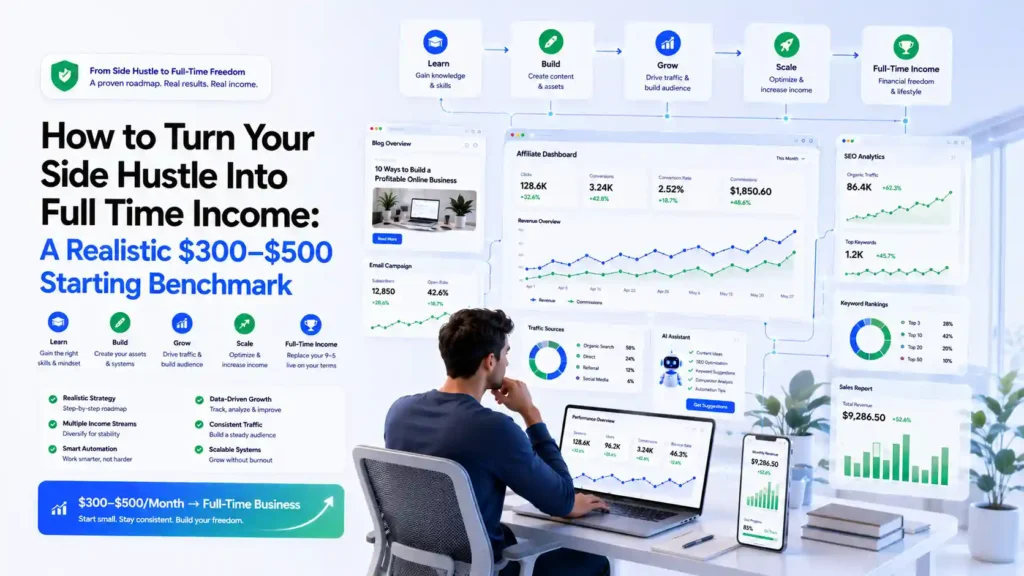
Step-by-Step Guide: How to Transition Safely
Follow this framework to move from side hustle to full time deliberately, not impulsively.
Step 1: Track Your True Income Replacement Number
Calculate not just your current take-home pay, but the full value of your job, including benefits like health insurance and any employer retirement contributions, so you know the real number your online income needs to cover.
Step 2: Hit That Number Consistently, Not Just Once
A widely used benchmark is reaching your full income replacement target for three to six consecutive months, rather than treating a single strong month as proof you’re ready.
Step 3: Build a Financial Cushion Before Quitting
A commonly recommended safety net is around six months of essential living expenses saved separately, giving you room to absorb a slow month or unexpected dip in income without panic.
Step 4: Address Debt and Fixed Costs First
Pay down high-interest debt where possible before making the leap, since carrying that alongside newly variable income adds significant financial pressure during an already uncertain transition.
Step 5: Plan for Taxes and Benefits Separately
Research how self-employment taxes work in your situation, and separately plan for how you’ll cover benefits like health insurance once they’re no longer provided through an employer.
Step 6: Consider a Bridge Period Instead of a Hard Cutoff
Where possible, consider reduced hours, a leave of absence, or a longer overlap period between your job and your online income, rather than an abrupt, all-or-nothing switch.
Step 7: Set a Clear Decision Date, Not a Feeling-Based One
Choose your transition date based on hitting your specific financial benchmarks, not based on frustration with your job or a particularly good month that may not repeat.
Uncover My Top Recommendation for Making $100-$300 Daily – Check Out This FREE Video to Begin >>>
What Changes When You Transition to Full Time Affiliate Marketing
Moving from side hustle to full time affiliate marketing specifically brings a few notable shifts beyond just having more hours available.
With more time, many people expect income to scale proportionally, but affiliate income doesn’t always respond linearly to more hours — it often depends more on strategic decisions, content quality, and diversification than on raw time invested.
This makes the earlier steps in this guide, like building multiple income streams and validating consistency, especially important before making the full-time leap specifically around affiliate marketing.
Full-time transition also often means treating the business more formally — separating business and personal finances, setting up proper bookkeeping, and paying quarterly estimated taxes, since none of this is handled automatically the way it was through payroll.
Common Mistakes When Trying to Replace a Salary Online
- Quitting after one strong month. A single spike in income isn’t the same as a reliable, repeatable baseline.
- Ignoring the full value of a job’s benefits. Health insurance, retirement contributions, and tax withholding are easy to underestimate when calculating your true replacement number.
- Skipping the financial cushion. Quitting without a safety net turns a normal slow month into a genuine crisis.
- Underestimating self-employment taxes. Many new business owners are caught off guard by owing significantly more in taxes than they expected as an employee.
- Making the decision emotionally rather than financially. Frustration with a job is a valid feeling, but it isn’t a substitute for a clear, number-based readiness check.
Pro Tips for a Smoother Transition
Build your financial benchmarks into a simple monthly tracking habit well before you’re close to quitting, so you have real, honest data instead of a rough guess when the decision point arrives.
Talk to a financial or tax professional before making the leap, since self-employment taxes, health insurance options, and benefit replacement vary significantly based on your personal situation and location.
Consider negotiating a gradual transition with your employer, like reduced hours, if that option is available and your finances can support the reduced income during the shift.
Revisit your income diversification before quitting, since relying on a single online income source going into a full-time transition carries more risk than having two or three stable streams in place.
Finally, give yourself permission to delay the decision if your numbers aren’t quite there yet — a few extra months of preparation is a minor cost compared to the risk of an underprepared transition.
FAQs
1. How do I know when it’s time to turn my side hustle into full time income?
A common benchmark is consistently replacing your full income, including the value of benefits, for three to six consecutive months, alongside having a financial cushion in place.
2. Should I quit my job before or after my side income matches my salary?
Most financial guidance suggests waiting until your side income has consistently matched or exceeded your full income replacement number for several months, not quitting the moment you first hit it once.
3. How much should I save before quitting my job for an online business?
A commonly recommended benchmark is around six months of essential living expenses saved as a cushion, though your specific number should reflect your own expenses and risk tolerance.
4. What changes financially when I transition to full time affiliate marketing?
You’ll typically take on self-employment taxes, lose employer-provided benefits like health insurance, and need to manage more variable income, all of which should factor into your replacement number.
5. Is it risky to quit my job for an online business?
It can be, especially without proper financial preparation. Following a structured framework around consistent income, savings, and debt reduction significantly reduces that risk.
6. Can I transition gradually instead of quitting all at once?
Yes, and many people find this safer. Reduced hours, a leave of absence, or an extended overlap period can ease the transition compared to an abrupt, all-or-nothing switch.
7. What’s the biggest mistake people make when replacing their salary online?
Treating a single strong month as proof of readiness is one of the most common mistakes, since consistency over several months is a far more reliable indicator than one good result.
Uncover My Top Recommendation for Making $100-$300 Daily – Check Out This FREE Video to Begin >>>
Conclusion: Make the Leap From Readiness, Not Excitement
Turning a side hustle into full time income is one of the biggest financial decisions many online entrepreneurs make, and it deserves the same careful planning as any major life transition.
Consistency, a financial cushion, and honest tax and benefit planning matter far more than a single good month.
Track your true replacement number, build your cushion, and set a decision date based on your data, not your mood.
Ready to plan your transition the smart way? Calculate your full income replacement number today, and start tracking your progress toward it consistently before setting a firm quit date.
Source: How to Turn Your Side Hustle Into Full Time Income: A Realistic $300–$500 Starting Benchmark
Affiliate Disclaimer :
Some of the links in this article may be affiliate links, which means I receive a small commission at NO ADDITIONAL cost to you if you decide to purchase something. While we receive affiliate compensation for reviews / promotions on this article, we always offer honest opinions, user experiences and real views related to the product or service itself. Our goal is to help readers make the best purchasing decisions, however, the testimonies and opinions expressed are ours only. As always you should do your own thoughts to verify any claims, results and stats before making any kind of purchase. Clicking links or purchasing products recommended in this article may generate income for this product from affiliate commissions and you should assume we are compensated for any purchases you make. We review products and services you might find interesting. If you purchase them, we might get a share of the commission from the sale from our partners. This does not drive our decision as to whether or not a product is featured or recommended.