Relying on one online income source can feel efficient — until that source changes.
An algorithm update, a program shutting down, or a platform policy shift can quietly wipe out income you assumed was stable.
This guide covers how to build multiple income streams online, a practical income diversification strategy for beginners, and how to combine affiliate marketing and freelancing into a setup that’s far more resilient than relying on just one thing.
Uncover My Top Recommendation for Making $100-$300 Daily – Check Out This FREE Video to Begin >>>
What Does It Mean to Have Multiple Income Streams Online?
Having multiple income streams online means earning money through more than one independent source, so that no single platform, client, or program controls your entire income.
For online entrepreneurs and creators, common income streams include:
- Affiliate marketing, earning commissions by promoting other companies’ products
- Freelancing, offering a specific skill like writing, design, or virtual assistance to clients
- Digital products, such as templates, courses, or ebooks sold directly to an audience
- Ad revenue, earned through content platforms like blogs or YouTube
- Sponsorships or partnerships, where brands pay directly for promotion or content
The goal isn’t necessarily to run five full businesses at once — it’s to build two or three income sources that don’t all depend on the same platform, algorithm, or client relationship.
Why Diversifying Online Income Matters So Much
Beginners often assume diversification is something to worry about later, once they’re already earning well. In reality, it matters from a much earlier stage than most expect.
- It protects against single points of failure. A platform policy change, algorithm update, or lost client can seriously damage income that depends entirely on one source.
- It compounds over time. Skills and audiences built for one income stream, like content creation, often directly support a second, like affiliate marketing or digital products.
- It correlates strongly with higher earnings. Data on online creators consistently shows that people running several income streams tend to significantly out-earn those relying on just one, since no single source is forced to carry the entire load.
- It smooths out inconsistency. Different income streams often perform differently month to month, so a dip in one can be offset by stability or growth in another.
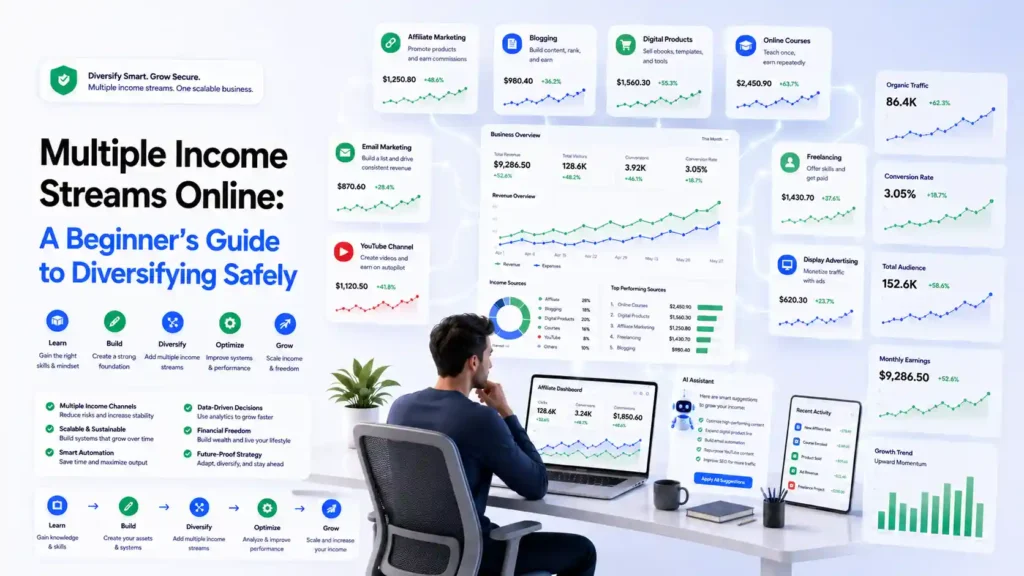
Step-by-Step Guide: How to Build Multiple Income Streams Online
Follow this order to diversify without spreading yourself too thin too early.
Step 1: Get One Income Stream Genuinely Stable First
Resist the urge to launch several income sources simultaneously. Build real consistency in one — enough traffic, clients, or sales to call it dependable — before adding a second.
Step 2: Choose a Second Stream That Complements the First
Look for a second income source that naturally reinforces your existing skills or audience, rather than starting something entirely unrelated. A content-based affiliate income, for example, pairs naturally with freelance writing or a digital product built around the same audience.
Step 3: Combine Affiliate Marketing and Freelancing Strategically
These two pair especially well for beginners. Affiliate marketing can generate more passive, ongoing income from existing content, while freelancing offers more immediate, predictable income from client work — together, they balance each other’s weaknesses.
Step 4: Build Toward an Owned Asset
Where possible, work toward income streams tied to something you own, like an email list, a personal brand, or your own digital product, rather than relying entirely on income sources controlled by outside platforms or programs.
Step 5: Set Boundaries to Avoid Overextension
Define how much time each income stream reasonably deserves, so managing several sources doesn’t quietly turn into doing five things poorly instead of two or three things well.
Step 6: Track Each Stream Separately
Monitor the performance of each income source individually, so you can clearly see which ones are genuinely growing and which ones might need adjusting or eventually dropping.
Uncover My Top Recommendation for Making $100-$300 Daily – Check Out This FREE Video to Begin >>>
How to Combine Affiliate Marketing and Freelancing Effectively
This particular pairing works well because the two income types behave differently, which is exactly what makes diversification valuable.
Freelancing tends to provide more immediate, predictable income tied directly to hours worked or projects completed, which is useful for covering near-term expenses.
Affiliate marketing, by contrast, often takes longer to build but can eventually generate income with less ongoing time investment per dollar earned, since content and links keep working after they’re published.
Many beginners use freelancing income to stabilize their finances while affiliate marketing grows in the background, gradually shifting more time toward affiliate work as it becomes more consistent and freelance hours become less necessary to cover expenses.
Common Mistakes When Diversifying Online Income
- Starting too many income streams at once. Spreading effort too thin early on often means none of them get the attention needed to actually succeed.
- Choosing unrelated income streams. Picking sources that share no audience or skill overlap makes each one harder to build and maintain.
- Neglecting a strong first income stream to chase a second. A shaky primary source undermines the entire diversification strategy.
- Ignoring which streams are underperforming. Continuing to invest equal time into a stream that isn’t growing wastes resources that could go toward a stronger one.
- Treating diversification as an excuse to avoid depth. A handful of shallow, half-built income sources is usually weaker than two or three genuinely developed ones.
Pro Tips for a Smarter Income Diversification Strategy
Look for income streams that share the same underlying asset, like an audience or content library, so growth in one naturally supports growth in another instead of requiring separate effort from scratch.
Set a specific review schedule — quarterly works well for many people — to assess which income streams are actually growing and which deserve less time or should be phased out.
Prioritize at least one income stream tied to something you own, like an email list or personal brand, so your overall income isn’t entirely dependent on platforms or programs you don’t control.
Resist adding a new income stream simply because it’s trending; choose based on genuine fit with your skills, audience, and existing workflow instead.
Finally, remember that diversification is a long-term structural decision, not a quick fix — expect it to take real time to build each stream to a meaningful level, rather than expecting immediate results across all of them at once.
FAQs
1. Why are multiple income streams important for online business?
Relying on a single income source leaves you vulnerable to algorithm changes, platform policy shifts, or lost clients, while multiple streams spread that risk and often lead to stronger overall earnings.
2. How many income streams should a beginner aim for?
Most beginners are better served starting with one stable income source and gradually adding a second and third over time, rather than attempting several at once.
3. What’s the best way to combine affiliate marketing and freelancing?
Many beginners use freelancing for more immediate, predictable income while building affiliate marketing in the background, gradually shifting time toward affiliate work as it becomes more consistent.
4. Is stacking income streams the same as being unfocused?
Not when done deliberately. Effective stacking involves choosing complementary income sources that share an audience or skill set, rather than pursuing unrelated ventures simultaneously.
5. How long does it take to build a second income stream?
Timelines vary, but most beginners should expect a second stream to take real time to become meaningful, especially if it’s being built while still growing a first one.
6. Should I diversify before my first income stream is stable?
Generally, it’s better to build genuine consistency in one income source first, since a shaky primary stream undermines the benefit of adding a second one too early.
7. What are the best income streams to combine for beginners?
Affiliate marketing paired with freelancing is a common and effective combination, since freelancing offers more immediate income while affiliate marketing builds toward more passive, longer-term earnings.
Uncover My Top Recommendation for Making $100-$300 Daily – Check Out This FREE Video to Begin >>>
Conclusion: Build Depth Before You Build Width
Multiple income streams online aren’t about doing everything at once — they’re about deliberately building a second and third source that protects and complements a genuinely stable first one.
The strongest setups come from depth first, then thoughtful diversification.
Get one income stream stable, choose a complementary second one, and track each source separately as you grow.
Ready to start diversifying your online income? Identify one complementary income stream to your current work, and commit to building it steadily over the next few months.
Source: Multiple Income Streams Online: A Beginner’s Guide to Diversifying Safely
Affiliate Disclaimer :
Some of the links in this article may be affiliate links, which means I receive a small commission at NO ADDITIONAL cost to you if you decide to purchase something. While we receive affiliate compensation for reviews / promotions on this article, we always offer honest opinions, user experiences and real views related to the product or service itself. Our goal is to help readers make the best purchasing decisions, however, the testimonies and opinions expressed are ours only. As always you should do your own thoughts to verify any claims, results and stats before making any kind of purchase. Clicking links or purchasing products recommended in this article may generate income for this product from affiliate commissions and you should assume we are compensated for any purchases you make. We review products and services you might find interesting. If you purchase them, we might get a share of the commission from the sale from our partners. This does not drive our decision as to whether or not a product is featured or recommended.